
2026 strategic initiatives: Two ways we're making education matter more
This year, Edovo is launching two initiatives that will shape our work for years to come: helping learners find direction in their education, and ensuring that direction translates into real outcomes in the moments that define their futures.
For more than a decade, Edovo has operated on a foundational belief: there is human potential behind bars. That belief has driven us to build a free digital learning platform that now reaches more than 60% of the incarcerated population — a group that, not long ago, had access to meaningful educational programming at a rate of fewer than one in five.
Access was always the first problem to solve. But it was never the only one.
This year, we're launching two initiatives that will shape and define Edovo's work for years to come, ensuring that learning on Edovo leads somewhere, and ensuring that somewhere actually counts.
Initiative 01: Personalized Journeys
Turning access into direction
Edovo has already solved one of the hardest problems in correctional education: access. More than 2 million learners across 1,500+ facilities can open a tablet and choose to invest in themselves. Historically, fewer than 20% of incarcerated people had access to any educational programming at scale. Today that number is over 60%.
But access alone doesn't change lives. Direction does.
The problem isn't motivation. It's momentum.
When we asked our learners directly, the data was unambiguous: 80% said they want to use Edovo for goal-setting. 73% believe Edovo can help them achieve their goals. The number one thing they told us they wanted to build? A daily learning habit.
The intent is there. What's been missing is the system to sustain it.
Here's what that gap looks like in practice. A learner logs in. They browse. They start something. They come back a few days later and start something else. Not because they aren't motivated, but because nothing in the platform is connecting their choices to a direction that feels like theirs. Over time, even the most motivated learner can drift.
Research on long-term behavior change is consistent on this point: lasting change is most likely when someone chooses a direction that matters to them and has the support to keep building on it. Exposure to opportunity isn't enough. People need to make a personal decision to invest in themselves and then have a system that helps them honor that decision over time.
That's the gap Personalized Journeys is designed to close.

What we're building and why it's hard.
At Edovo's scale — 2 million learners, 1,500+ facilities, widely varying literacy levels, digital familiarity, and life circumstances — you cannot solve this problem manually. Static categories and periodic content updates cannot adapt quickly enough to reflect how individual learners actually engage. What works for one learner at one facility in one moment of their sentence is completely different from what works for another.
AI changes the equation. AI allows us to move from a static library to a living, responsive system: one that continuously interprets signals of engagement and uses them to improve how content is surfaced, connected, and recommended in real time. We're talking about infrastructure.
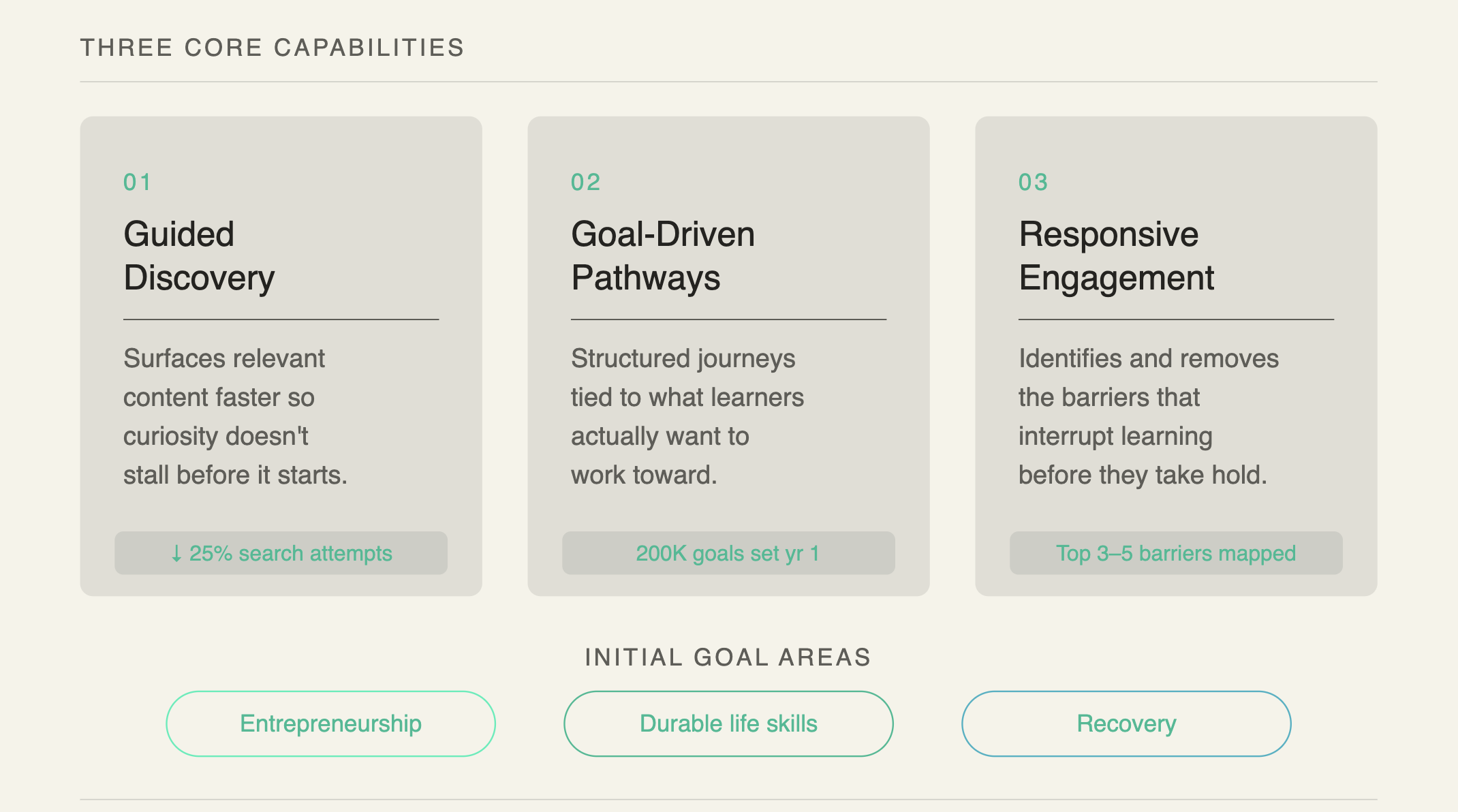
Three capabilities sit at the center of this work:
Guided Discovery.
Right now, finding the right content requires a learner to already know what they're looking for. We're changing that. AI-powered infrastructure will surface relevant content faster, reducing the friction between intention and engagement.
Our target: a 25% reduction in average search attempts before a learner engages, and a 30% reduction in "load-more" clicks per session.
Goal-Driven Pathways.
In 2025, we ran prototyping sessions directly inside two correctional facilities to test whether structured goal-setting would resonate. The feedback shaped everything about how we're building this. We're launching with three initial goal areas learners told us they want (entrepreneurship, durable life skills, and recovery) each with curated content, clear progress indicators, and contextual guidance on what to do next.
Our target: 1 million learners with access to goal-setting, 200,000 setting at least one goal in year one, and goal-setting learners completing 20% more goal-aligned content than those without.
Responsive Engagement Understanding.
We can't build a personalized system without first understanding what actually interrupts learning in this environment. For this population, where learning differences, trauma exposure, and varying levels of digital familiarity are significantly more prevalent than in the general population, standard accessibility frameworks aren't enough.
We're launching a structured initiative combining learner surveys, staff feedback, onboarding data, and behavioral analysis to identify and prioritize the top three to five barriers to sustained engagement. The outcome is a prioritized roadmap for what we fix next.
Together, these three capabilities form a system. And like any system, its value is measured by outcomes.
Here's what success looks like in year one, and what learners told us they most want to work toward.

What sustained engagement actually produces.
Goal-aligned engagement is closely tied to outcomes that extend well beyond the platform: reentry readiness, participation in programming, and long-term stability after release.
When a learner sets a goal, connects to content that serves it, and builds a daily habit around it, something shifts. They start to see themselves as someone capable of progress. That identity shift (what researchers call pro-social identity development) is one of the most reliable predictors of successful reentry.
Edovo already has the reach to make this possible at national scale. Personalized Journeys is how we make that reach matter more.
Initiative 02: Making It Count
Turning achievement into opportunity
Something important is already happening on the platform. Learners aren't waiting for the system to be ready. They're bringing their Edovo transcripts into parole hearings, sharing them with judges at sentencing, and using them to make the case that they're ready for a second chance.
The question is whether the system is ready to listen.
In Q1 2026, we surveyed 57,400 learners about what happened when they shared their Edovo transcripts or certificates outside their facility. What we found confirmed what we suspected: this is already working, just not consistently enough.
14,605 learners shared their transcripts. Here's what happened.
Of the 57,400 surveyed, more than 14,600 reported sharing their transcripts or certificates with a judge, attorney, case manager, or family member. That's not a small pilot. That's a movement happening without any formal infrastructure to support it.

The outcomes among those who shared tell a clear story:

Each number represents a person who walked into a high-stakes hearing, put their transcript on the table, and had it change something. The $1.7 million in documented bail savings comes from just 14 cases where respondents provided specific figures. The full projection across all 59 confirmed bail reductions is $2M–$7.2M.
892 people had their sentences reduced. Together, that's 2,099 years.
Among post-sentence learners, the data gets even more striking. Of those who attempted to use their transcripts at parole or sentencing, 16% confirmed a reduction in their time. Across 507 cases where respondents provided specific numbers, those reductions add up to approximately 2,099 documented years: six life sentences commuted, 41 people granted parole citing their Edovo work directly.
To put that in human terms: that is 2,099 years of people's lives returned to them, to their families, and to their communities. And it happened through education.

The most unexpected finding: words alone work nearly half the time.
21,506 learners reported advocating for themselves verbally, simply talking about what they'd learned, without a transcript or certificate in hand. Of those who completed the follow-up, 47% reported a positive outcome.
That number matters because it reframes the problem. This isn't only about getting transcripts printed and into courtrooms. It's about helping learners internalize and articulate their own growth, because when they can do that, nearly half the time something changes.

So why isn't this working for everyone?
The data above represents what's possible when things go right. But the gap between "sharing a transcript" and "having it recognized" remains wide — and it isn't random. Three structural barriers determine who gets heard and who doesn't.
Self-advocacy gaps. Many learners have the drive, but translating 200 hours of coursework into a compelling argument inside a high-stakes hearing is a skill that has to be built. Without it, hard-earned progress stays invisible.
System misalignment. Parole boards, judges, and attorneys operate under widely varying documentation standards. Whether a learner's progress is recognized often comes down to format, not substance: a problem no learner should have to solve alone.
Skepticism about digital learning. Because digital education is relatively new in correctional settings, many decision-makers simply aren't familiar with what Edovo courses measure. Even strong transcripts get discounted when the people reviewing them don't know what they're looking at.
These barriers are solvable. That's exactly what Making It Count is designed to do.
What we're going to do about it
Our strategy addresses each barrier directly through four workstreams:

Two initiatives. One through line.
Personalized Journeys and Making It Count aren't parallel tracks. They're a sequence. One builds the momentum; the other ensures it lands somewhere.
Together, they represent Edovo's commitment to moving beyond access: to a platform where learning is meaningfully guided, where achievement is credibly documented, and where the hours someone invests in themselves can actually change what happens next.
Hard work should open doors. These initiatives are how we start building them, and we're just getting started.
Want to learn more or get involved?
These initiatives are just getting started, and we believe the most meaningful progress happens in partnership. Whether you're a correctional agency looking to understand how Edovo transcripts can work within your system, a foundation interested in the research behind personalized learning, or an organization that wants to help fund this work and expand its reach. We'd love to hear from you.
If any part of this resonates with you, reach out to us at accounts@edovo.org. We're happy to walk you through the details of either initiative, share what we're seeing on the ground, and explore what a partnership could look like.
Help us build the infrastructure to make that happen.